Flight school: Dash 8#
This is how our scripts fly the DHC-8-200, and how you can fly it yourself. It is laid out like real pilot documentation: key data, instruments, briefing, checklists, callouts and clear limits for when to abort. The numbers apply to the FlightGear model with the patch and were checked in many test flights; for a real aircraft its flight manual always applies.
Key data#
Value |
Dash 8-200 in the model |
|---|---|
Rotate (VR) |
100 kt at light weight, rises with weight (about 102–107 kt) |
Initial climb |
130 kt up to 1000 ft above ground |
Climb |
170 kt, propellers 1050 rpm |
Cruise |
210 kt below FL150, 190 kt above |
Flaps |
0°, 5° (takeoff), 15°, 35° (landing) |
Max speed flaps 5°/15° |
148 kt |
Max speed flaps 35° |
130 kt |
Max gear speed (VLE) |
158 kt |
Vref (landing, flaps 35°) |
about 88–98 kt depending on weight |
Approach with flaps 15° |
Vref + 27 kt |
Single-engine landing |
flaps 15°, Vref + 18 kt |
Vref depends on landing weight: lift grows with the square of speed, so Vref rises with the square root of weight.
Instruments#
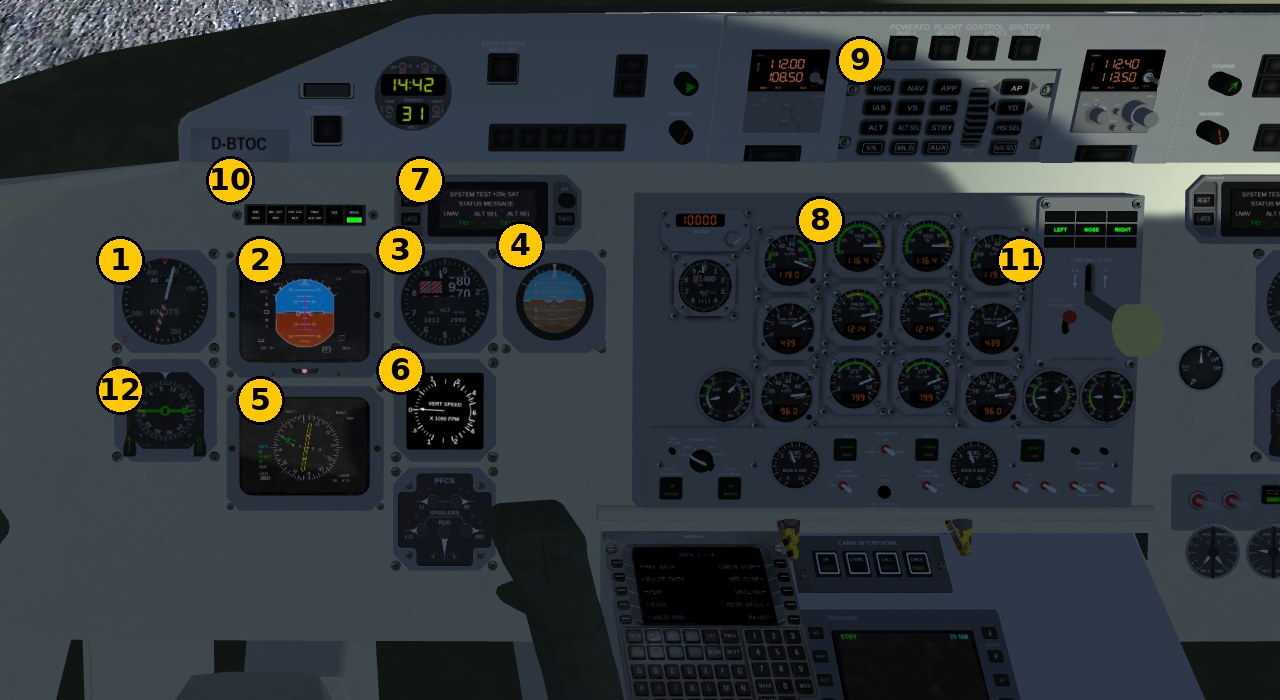
No. |
Instrument |
What to watch |
|---|---|---|
1 |
Airspeed indicator |
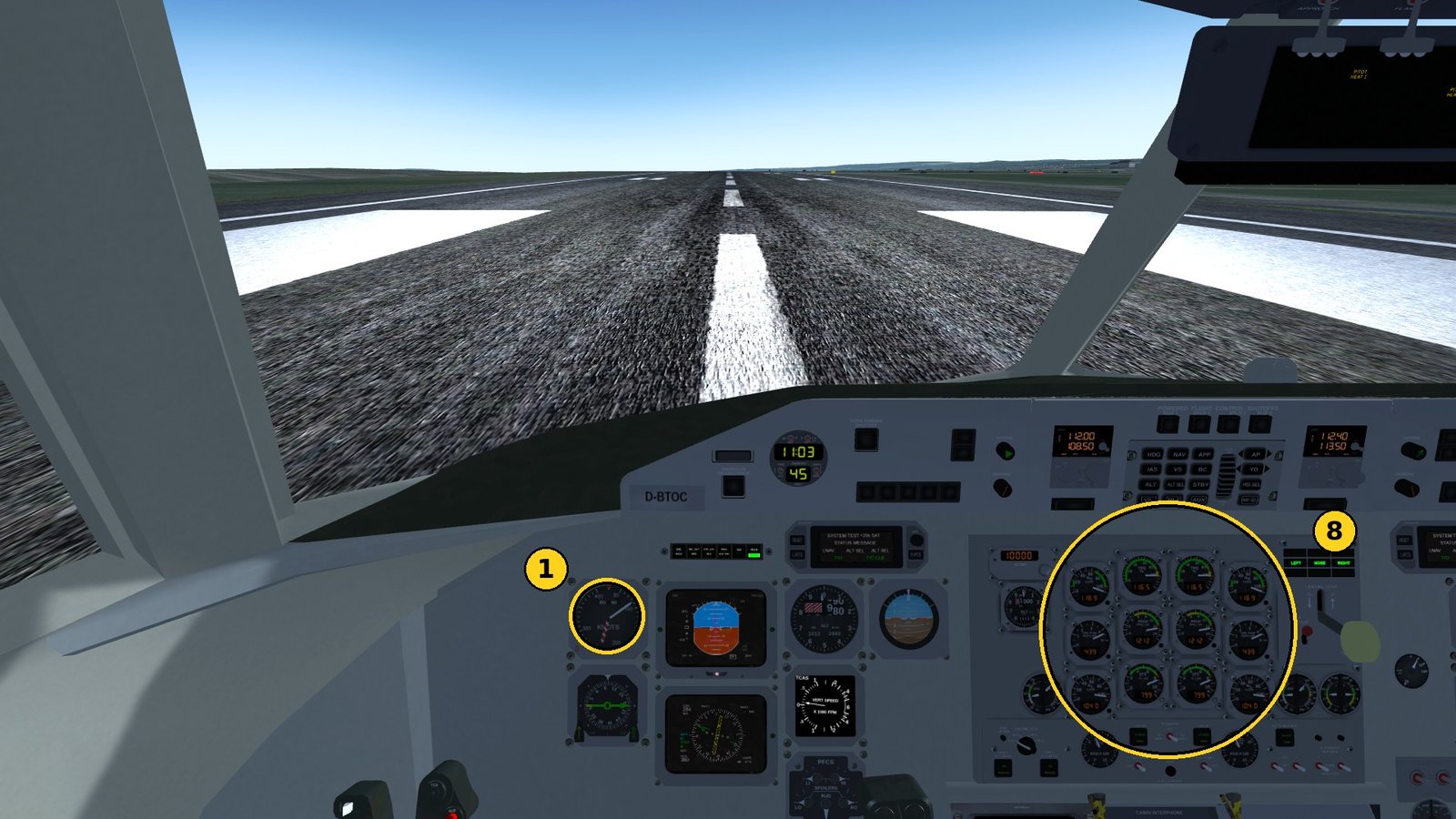
speed in knots, the red-white pointer is the maximum speed |
2 |
EADI (attitude) |
artificial horizon, flight director, autopilot modes at the top |
3 |
Altimeter |
altitude above sea level, pressure setting below (1013 hPa / 29.92) |
4 |
Standby horizon |
attitude if the EADI fails |
5 |
EHSI (heading) |
compass rose, course and navaid needles, ground speed (GSPD) |
6 |
Vertical speed with TCAS |
climb and descent rate in 1000 ft/min |
7 |
ID-802 |
autopilot display: active modes, selected values |
8 |
Engine instruments |
torque (TRQ), propeller rpm, ITT, NH, NL, fuel flow |
9 |
Autopilot panel |
HDG, NAV, APP, IAS, VS, ALT, AP, YD |
10 |
Annunciators |
DME HOLD, VOR LOC, REV and so on |
11 |
Gear lever with indicator |
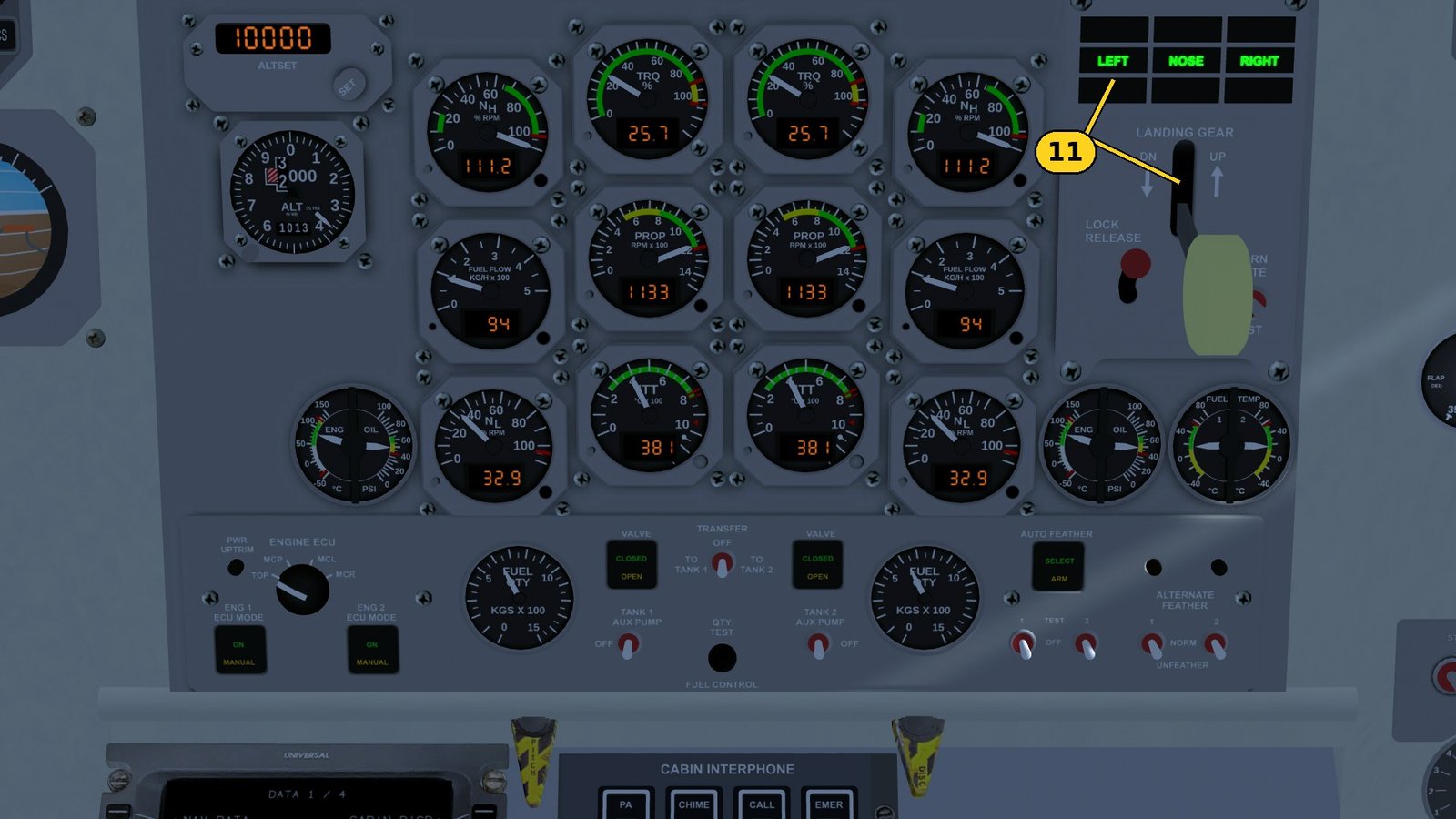
three green lights LEFT, NOSE, RIGHT = down and locked |
12 |
RMI |
needles to navaids (VOR, NDB) on a compass rose |
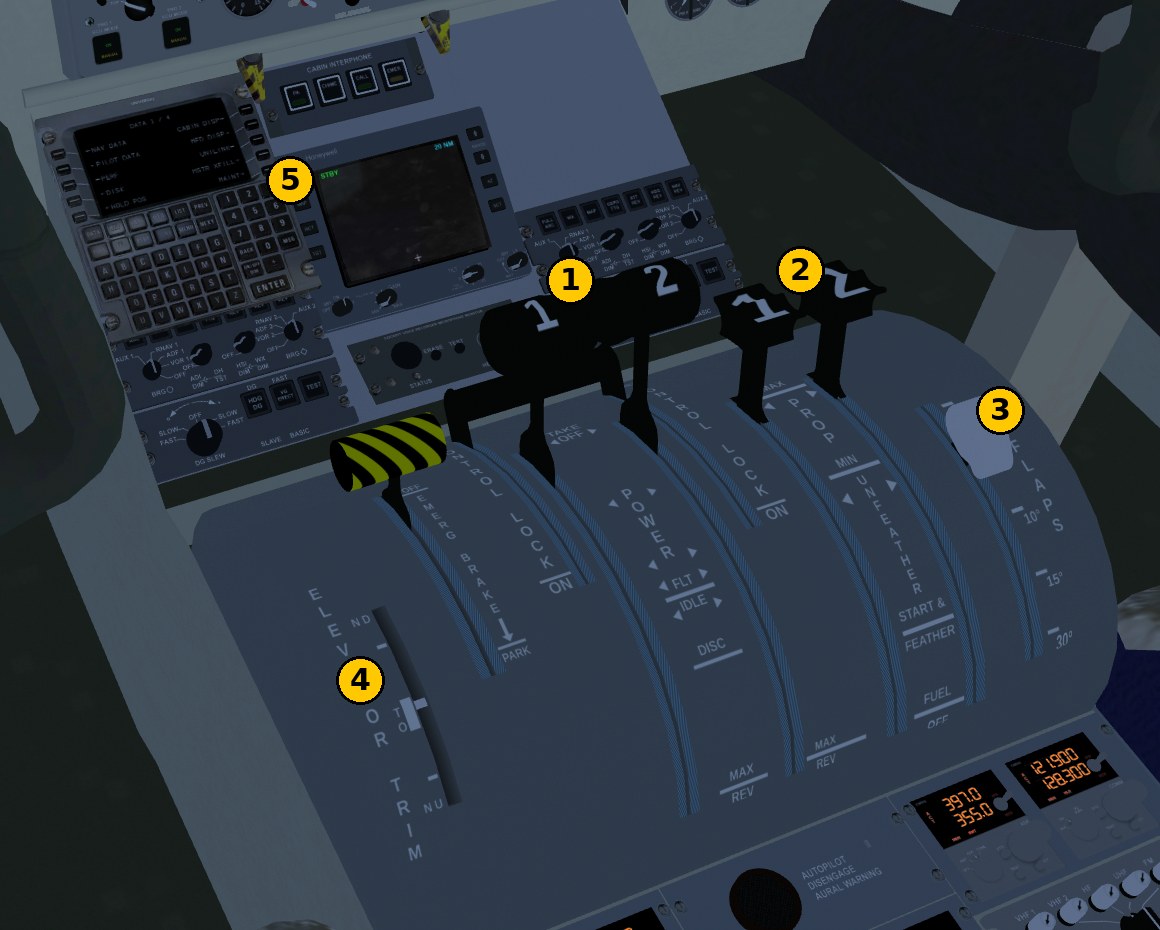
No. |
Control |
Meaning |
|---|---|---|
1 |
Power levers (POWER) |
thrust; fully aft DISC/reverse |
2 |
Propeller/condition levers |
rpm MAX 1200 for takeoff and landing, 1050 in climb; fully aft FUEL OFF |
3 |
Flap lever |
0°, 5°, 15°, 35° |
4 |
Elevator trim |
pitch trim |
5 |
Weather radar |
WX display, STBY on the ground |
Radios and radio calls: see Flight school: radio.
Switches for the engine start#
After loading, the Dash 8 is cold and dark: batteries off, engines off. The switches for the start are up in the overhead panel (to look up: hold the right mouse button and move the mouse).
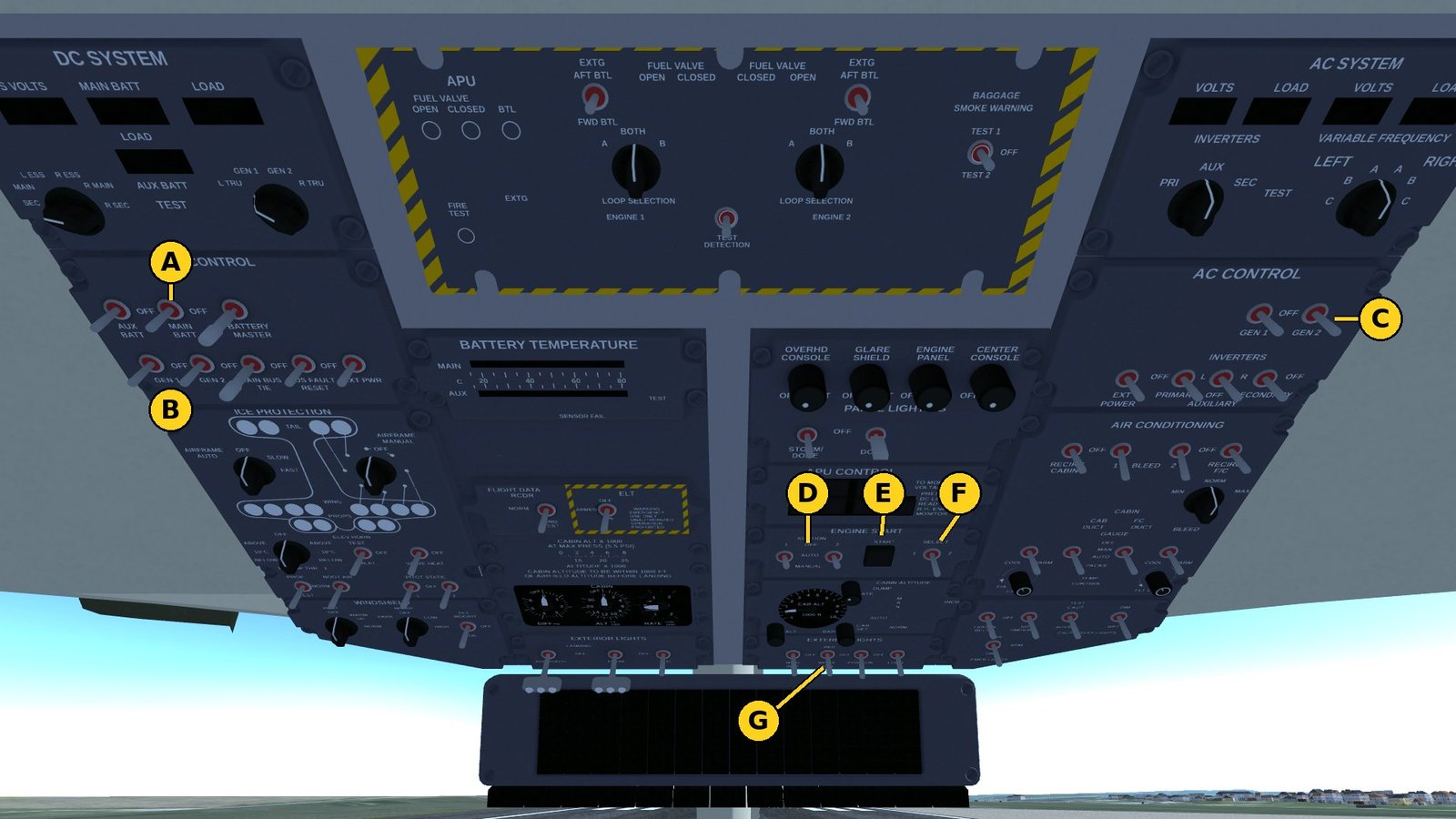
Control |
Where |
Positions |
|
|---|---|---|---|
A |
Batteries: AUX BATT, MAIN BATT, BATTERY MASTER |
DC CONTROL, top row left |
OFF / on |
B |
DC generators GEN 1, GEN 2 |
DC CONTROL, bottom row |
OFF / on |
C |
AC generators GEN 1, GEN 2 |
AC CONTROL, top right |
OFF / on |
D |
Ignition (IGNITION 1, 2) |
ENGINE START |
OFF, AUTO, MANUAL |
E |
Starter button START |
ENGINE START, centre |
push |
F |
Start selector SELECT |
ENGINE START, right |
1, off, 2 |
G |
Anti-collision light (ANTI-COLL) |
EXTERIOR LIGHTS, bottom centre |
off / on |
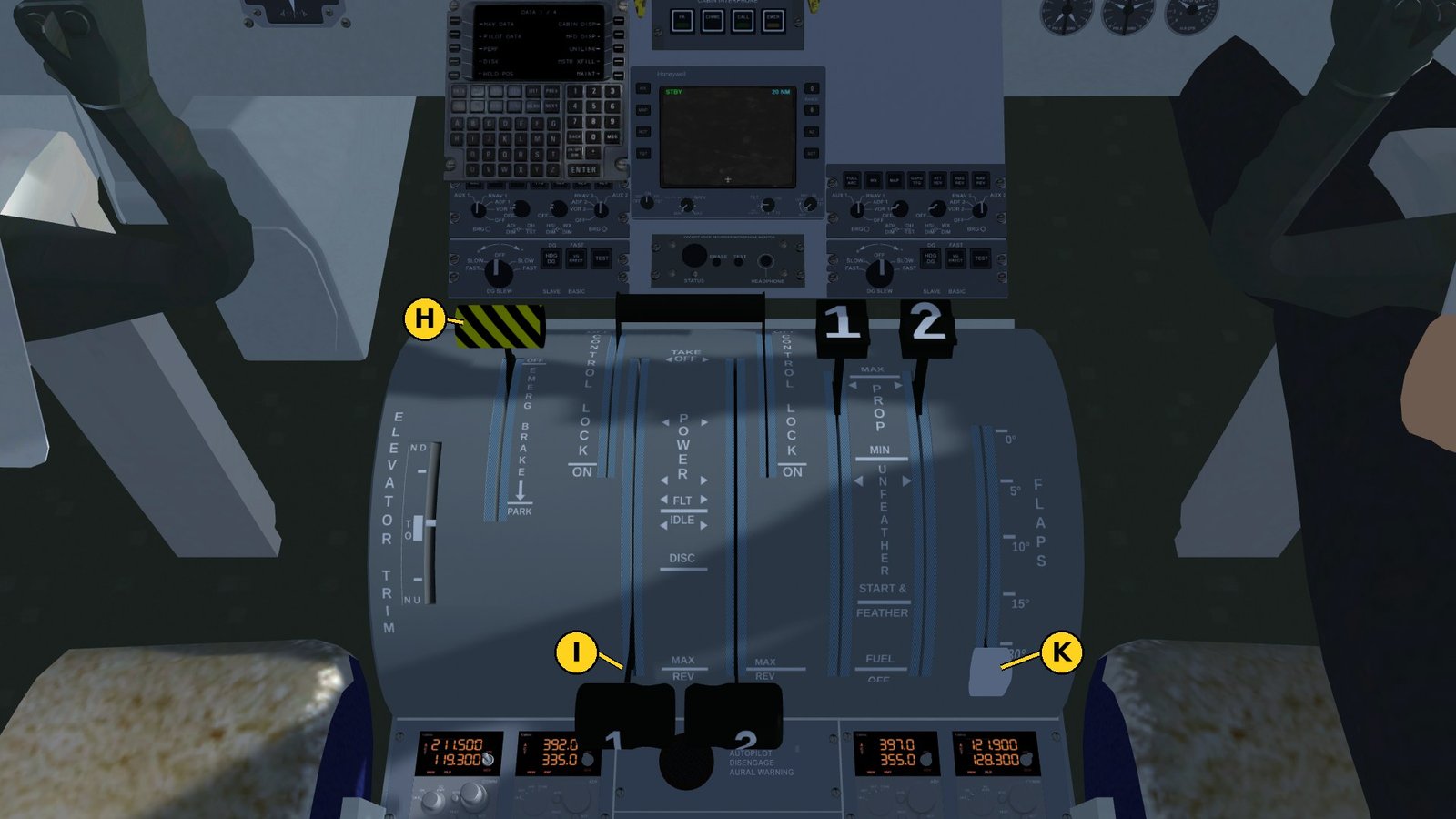
Power, fuel and propellers are on the centre pedestal:
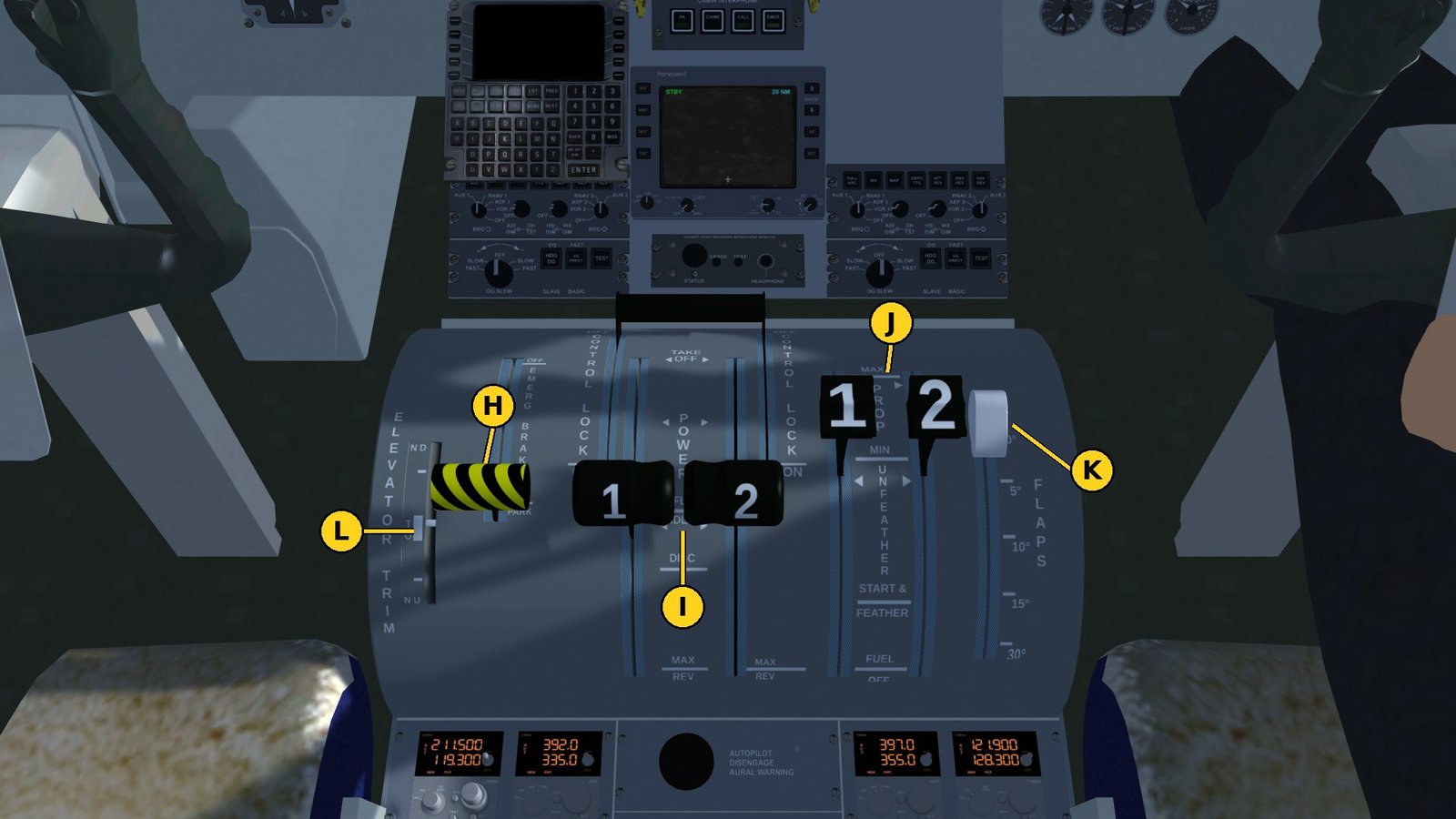
Control |
Positions |
Key |
|
|---|---|---|---|
H |
Parking brake (EMERG BRAKE, yellow and black) |
OFF / PARK |
|
I |
Power levers 1 and 2 (POWER) |
TAKE OFF, FLT IDLE, DISC, MAX REV (reverse) |
|
J |
Condition levers 1 and 2 (propeller and fuel) |
FUEL OFF, START & FEATHER, MIN–MAX (900–1200 rpm) |
|
K |
Flap lever |
detents 0°, 5°, 10°, 15° and landing |
|
L |
Elevator trim |
T/O mark for takeoff |
|
The last flap detent is labelled 30° on the lever; the model extends 35° there. Flown are 0°, 5° (takeoff), 15° and 35° (landing).
Engine start#
The quickest way is Help → Aircraft Checklists: the “PRE START-UP” and “Engines Start-Up” checklists can carry out the items themselves. By hand, in the same order (engine 2, the right one, first):
Step |
What |
Where |
How |
|---|---|---|---|
1 |
Parking brake set |
H |
|
2 |
Batteries on |
A |
click all three switches |
3 |
Power levers DISC, condition levers FUEL OFF |
I, J |
|
4 |
Ignition 1 and 2 to AUTO |
D |
click |
5 |
Anti-collision light on |
G |
click |
6 |
Start selector to 2 |
F |
click |
7 |
Push START |
E |
the START light comes on, NH (engine display) rises |
8 |
Fuel on |
J (lever 2) |
when NH rises above 10 %: condition lever 2 to START & FEATHER |
9 |
Check engine 2 |
displays |
ITT rises, at most 920 °C; the start selector returns by itself |
10 |
Engine 1 |
F, E, J |
as steps 6–9, selector to 1, condition lever 1 |
11 |
Propellers out of feather |
J |
both condition levers forward ( |
12 |
Generators on |
B, C |
DC GEN 1 and 2, AC GEN 1 and 2 |
In START & FEATHER the propeller turns feathered and NH stays at about 20 % in the model. That is not a failed start: only with the condition lever at MIN–MAX does the engine spool up to idle.
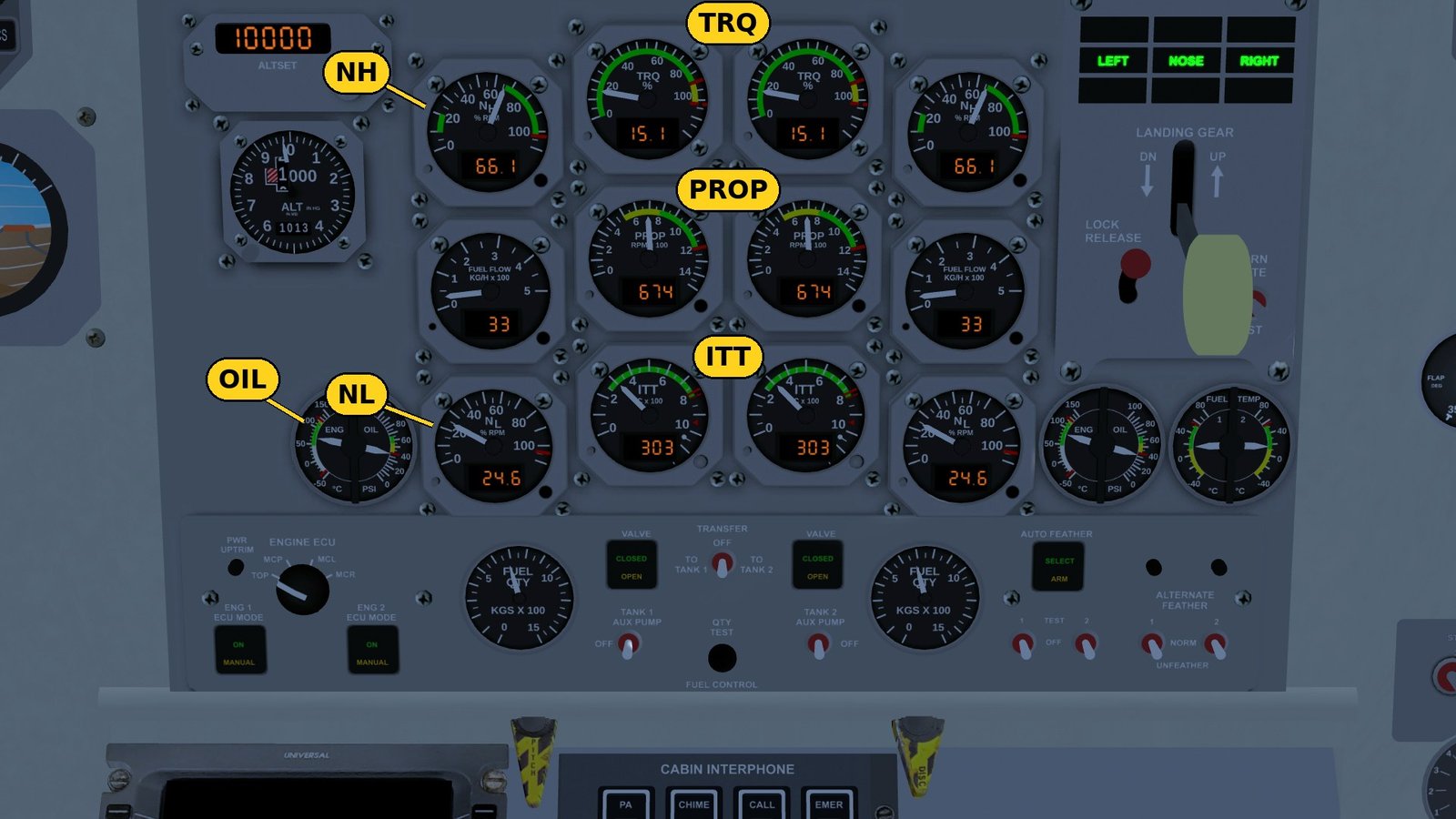
Display |
Meaning |
after the start |
|---|---|---|
NH |
high-pressure spool speed in % |
about 66 % |
TRQ |
torque in % |
low, power levers at DISC |
PROP |
propeller rpm |
a few hundred rpm on the ground |
ITT |
turbine temperature |
below 920 °C |
NL |
low-pressure spool speed in % |
about 25 % |
Oil |
temperature and pressure |
in the green |
Before takeoff#
Briefing (say it out loud before taxiing): runway and length, takeoff weight, VR, flaps 5°, departure route (straight ahead to 1500 ft above ground), what happens after an engine failure (abort before VR, after that continue and return).
Before takeoff checklist
Item |
Setting |
|---|---|
Parking brake |
released, feet on the brakes |
Flaps |
5° |
Propeller levers |
MAX (1200 rpm) |
Trim |
takeoff |
Transponder |
on |
Lights |
landing lights, strobes on |
Runway |
clear, on the centreline |
Takeoff#
When |
Callout |
Action |
|---|---|---|
Takeoff roll |
“Power set” |
power forward, keep the centreline with small pedal inputs (below 30 kt the nosewheel steers strongly) |
70 kt |
“70 knots” |
airspeed matches on both sides, engine values normal |
VR |
“Rotate” |
raise the nose smoothly to about 8° |
positive rate |
“Gear up” |
retract the gear, hold 130 kt |
1000 ft above ground |
“Flaps up” |
flaps 0°, accelerate to 170 kt, propellers 1050 |
Keys: power levers PgUp, gear up g (down G), flaps [ and ].
Traffic pattern#
This is how the traffic pattern script flies the left-hand pattern at Erfurt, recorded by the flight recorder:
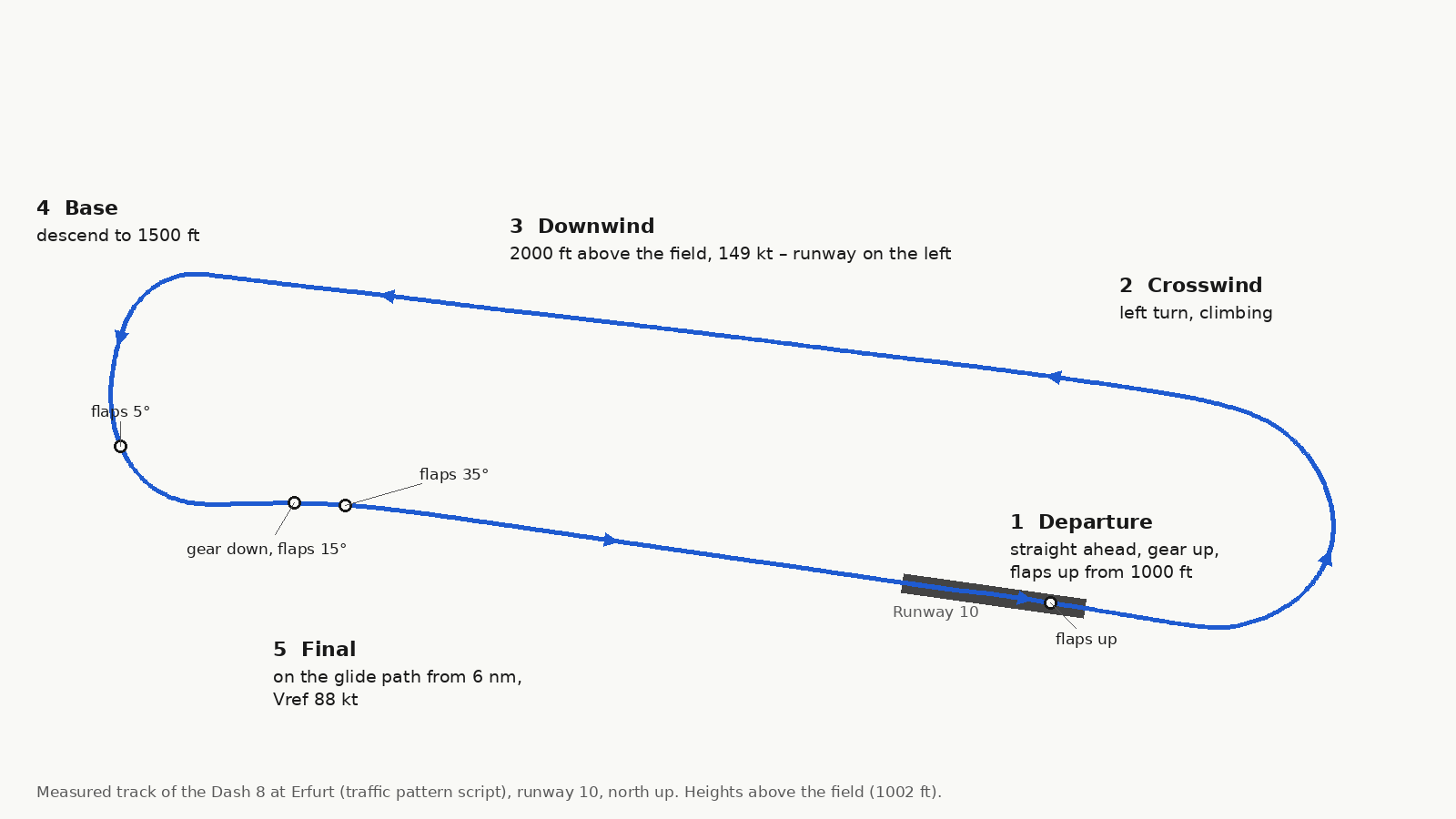
Leg |
Height above the field |
Speed |
Configuration |
|---|---|---|---|
Departure |
straight ahead to 1500 ft |
130 kt |
gear up with a positive rate, flaps up from 1000 ft |
Crosswind |
left turn, climb to 2000 ft |
up to 150 kt |
clean |
Downwind |
2000 ft |
about 150 kt |
clean, runway on the left, prepare landing checklist |
Base |
descend to 1500 ft |
140 kt |
flaps 5° below 140 kt |
Final |
from 1500 ft, 6 nm out |
on the glide path: gear (below 158 kt) and flaps 15°, below 122 kt flaps 35°, then Vref |
three green |
Which headings do you fly?#
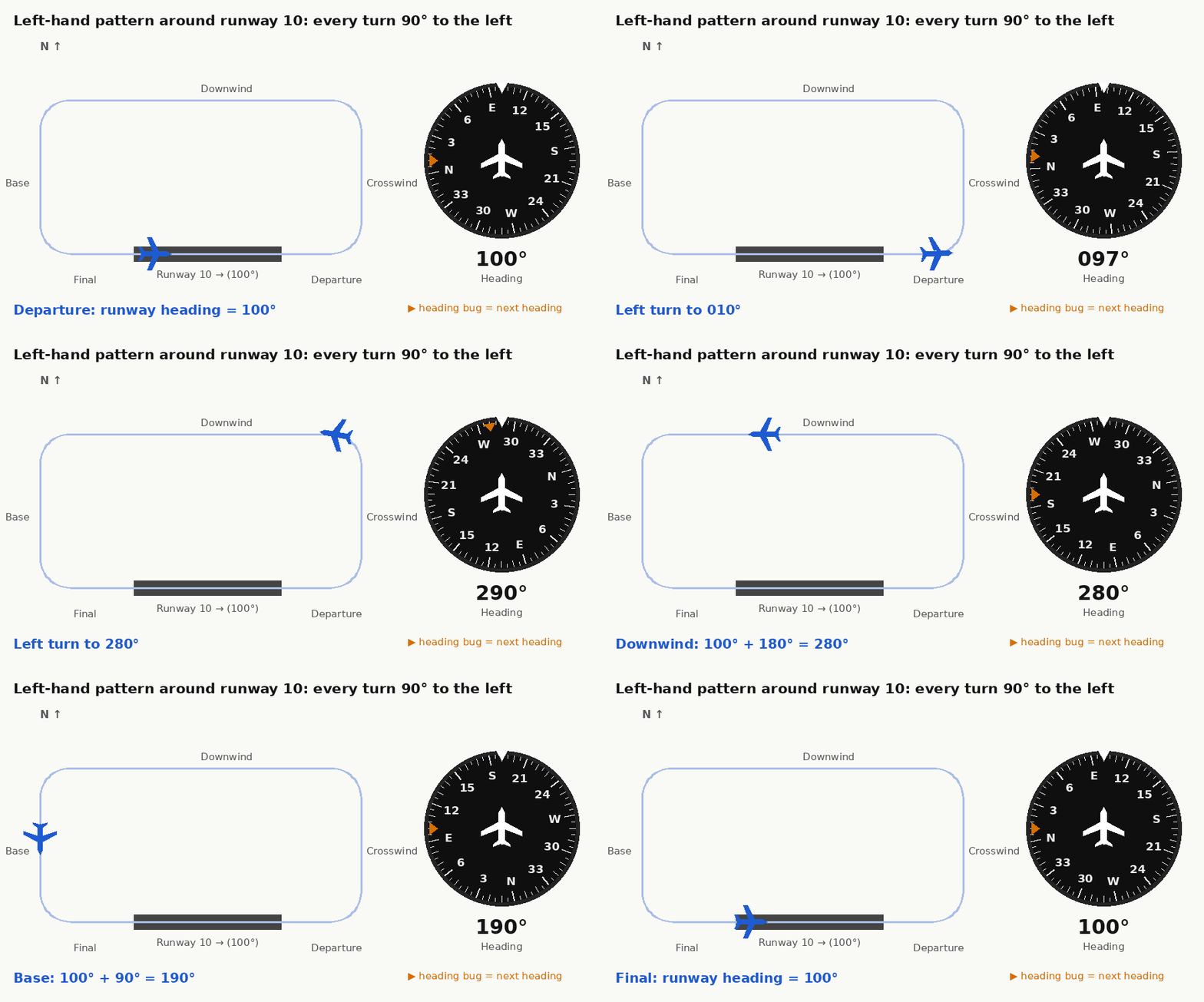
All headings follow from the runway direction. The runway number is the heading in tens of degrees: runway 10 means about 100°, runway 28 about 280° (the same runway, other direction). In a left-hand pattern every turn is a 90° left turn, so you subtract 90° each time:
Leg |
Calculation |
Example runway 10 |
|---|---|---|
Departure |
runway heading |
100° |
Crosswind |
runway heading − 90° |
010° |
Downwind |
runway heading + 180° (reciprocal) |
280° |
Base |
runway heading + 90° |
190° |
Final |
runway heading |
100° |
In a right-hand pattern the signs are reversed (crosswind +90°, base −90°). Whether the pattern is left or right is shown on the airfield’s visual approach chart; without a note it is left. Read the heading on the heading indicator (Cessna) or the EHSI (Dash 8) and set the heading bug (HDG knob) to the next heading, so you can see in the turn when to roll out.
When to turn:
Turn |
When |
|---|---|
onto crosswind |
past the end of the runway, once the departure height is reached |
onto downwind |
at the right distance from the runway (light aircraft usually 0.5–1 nm, the Dash 8 in the script 1.5 nm); downwind runs parallel to the runway |
onto base |
when the threshold is about 45° behind you (over your left shoulder) |
onto final |
early enough to roll out exactly on the extended centreline |
A 90° turn at standard rate (3° per second) takes 30 seconds. In a crosswind the headings are meant over the ground: the nose then points into the wind by the drift angle (see Crosswind).
Gear down and locked means three green lights LEFT, NOSE, RIGHT above the gear lever.
Bank angle in turns at most 25°, at most 15° with one engine.
Approach#
The glide path is 3°: the descent rate in ft/min is roughly the ground speed in knots times 5 (about 500 ft/min at 100 kt).
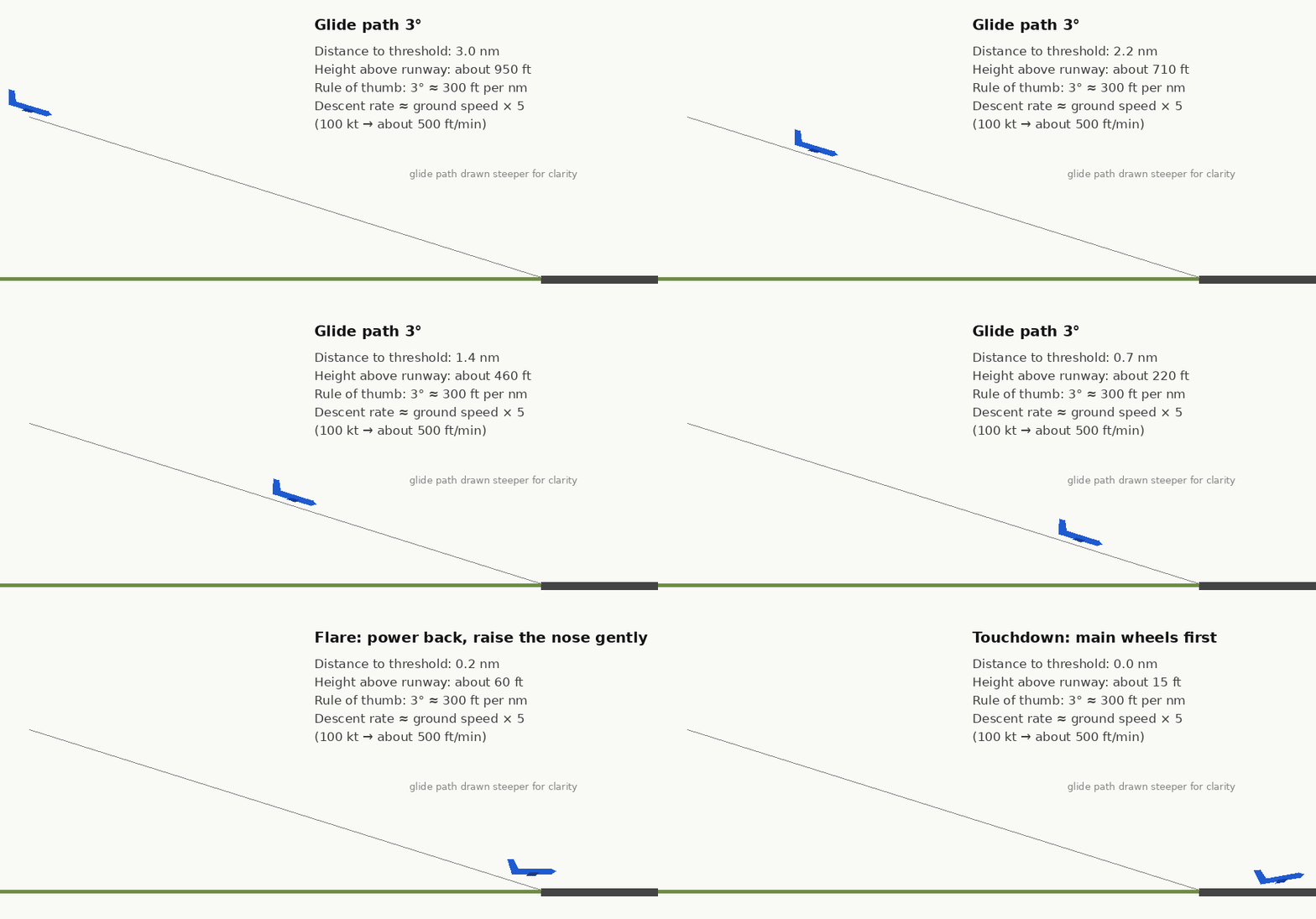
The animation draws the angle steeper for clarity; a real 3° path is very flat.
Stable at 300 ft above ground – otherwise go around:
Criterion |
Limit |
|---|---|
Distance from the centreline |
at most 25 m |
Speed |
Vref ± 12 kt |
Glide path |
at most 60 ft off |
Configuration |
gear down and locked, flaps 35° (15° with one engine) |
Real airlines usually require a stable approach already at 1000 ft (instrument conditions) or 500 ft (visual). The scripts’ 300 ft is the last check.
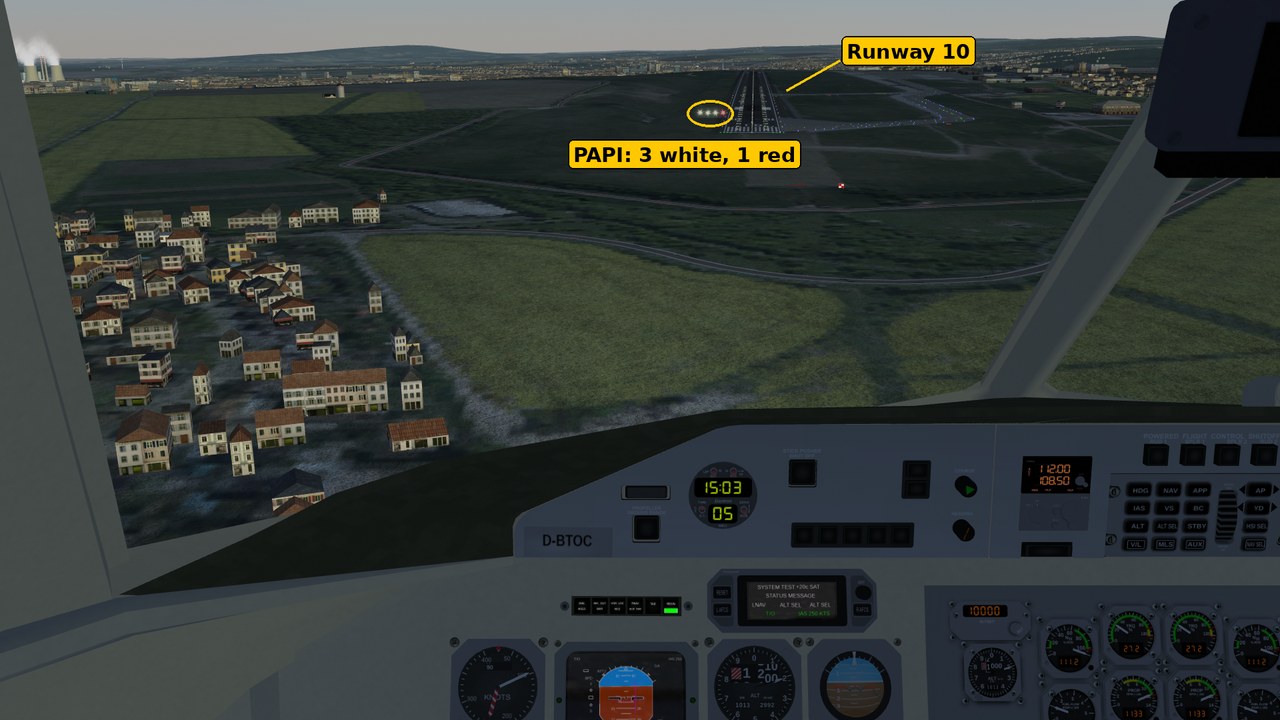
The PAPI is the row of four lights beside the runway. It shows the glide path without any instrument:
Lights |
Meaning |
|---|---|
4 white |
well too high |
3 white, 1 red |
slightly high |
2 white, 2 red |
on the path |
1 white, 3 red |
slightly low |
4 red |
well too low |
Landing#
When |
Action |
|---|---|
about 50 ft |
flare: power slowly to flight idle, raise the nose gently |
Touchdown |
main wheels first, aim point about 400 m past the threshold; below 300 ft/min is good, from 600 ft/min hard |
Main wheels on the ground |
power levers to DISC, lower the nosewheel gently |
Nosewheel down |
reverse ( |
40 kt |
reverse off, keep braking |
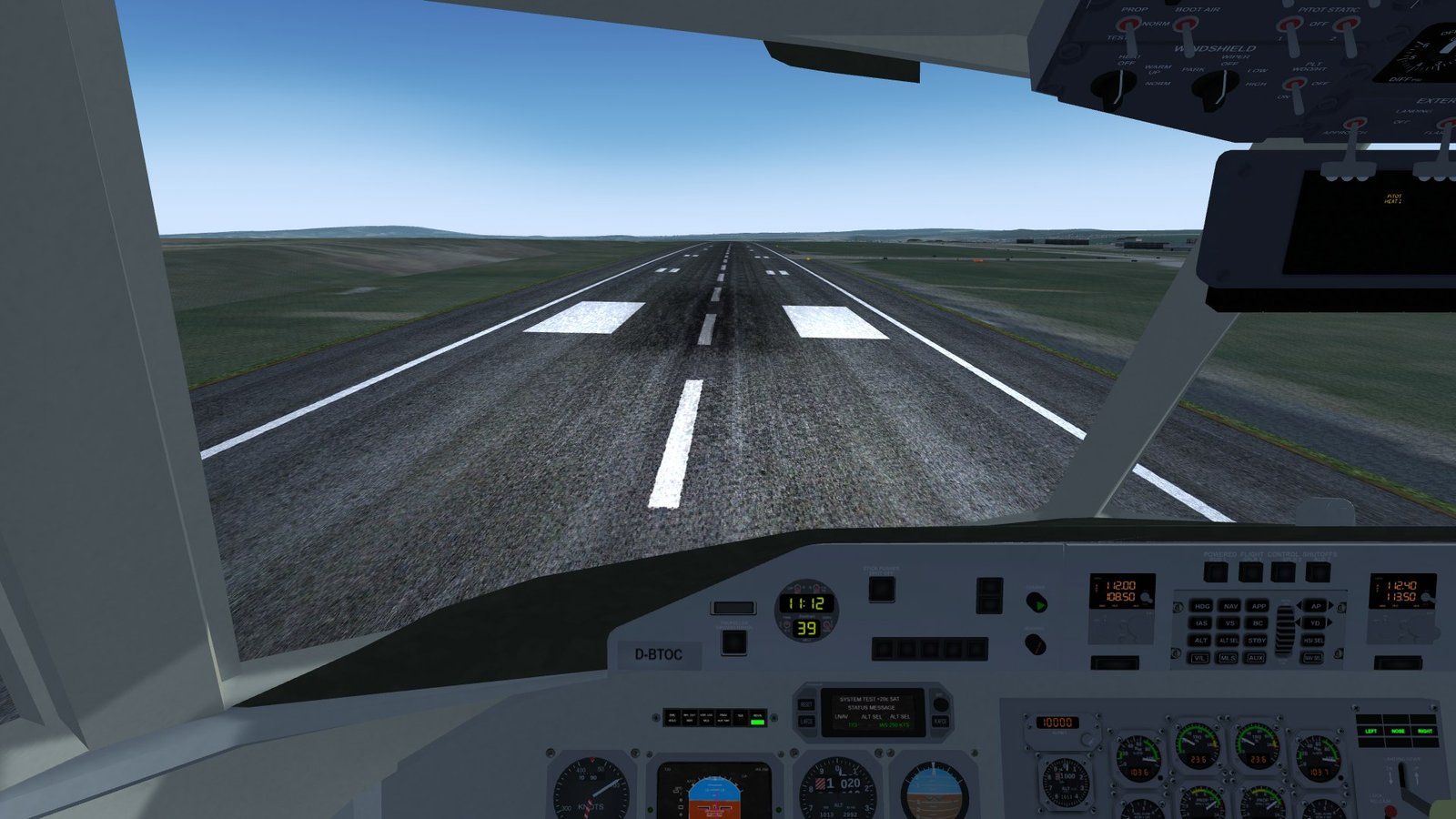
Go around even in the flare if a gust lifts the aircraft clearly (in the script 15 ft above the height where the climb began) or if it floats past the touchdown zone. A slight climb in the flare (ballooning) is not pushed down: hold the attitude, the aircraft settles by itself. Only add power if the speed drops below Vref − 5 kt.
Crosswind#
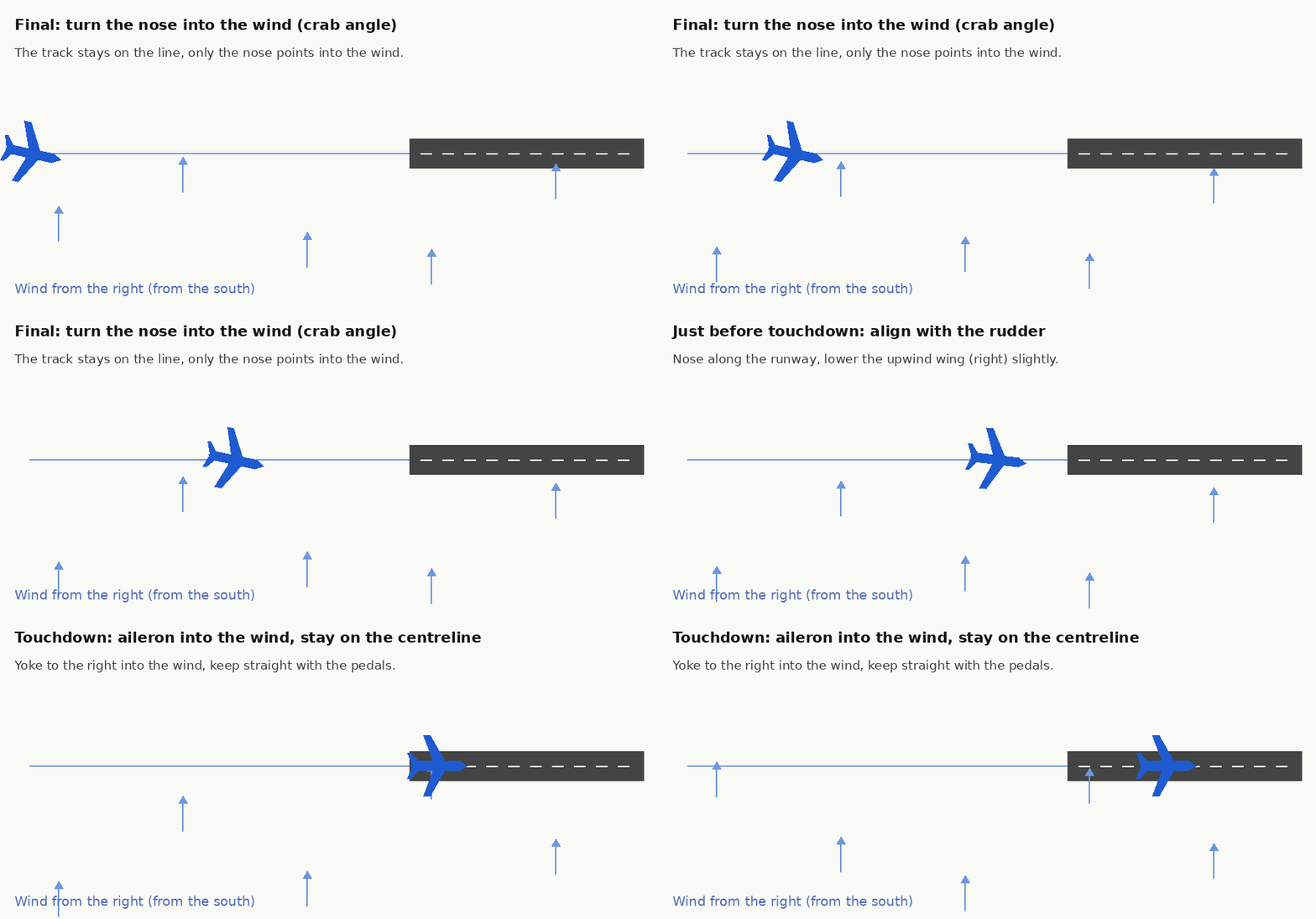
Phase |
Technique |
|---|---|
Final |
crab: nose into the wind, wings level |
Flare |
lower the upwind wing slightly (at most about 6°) so the aircraft does not drift |
just before touchdown (below 25 ft) |
align the nose with the runway using the rudder, slowly |
on the ground |
aileron into the wind, reduce reverse if the nose deviates |
Gusts: add the gust component (gust minus mean wind) to Vref as a reserve, at most 10 kt.
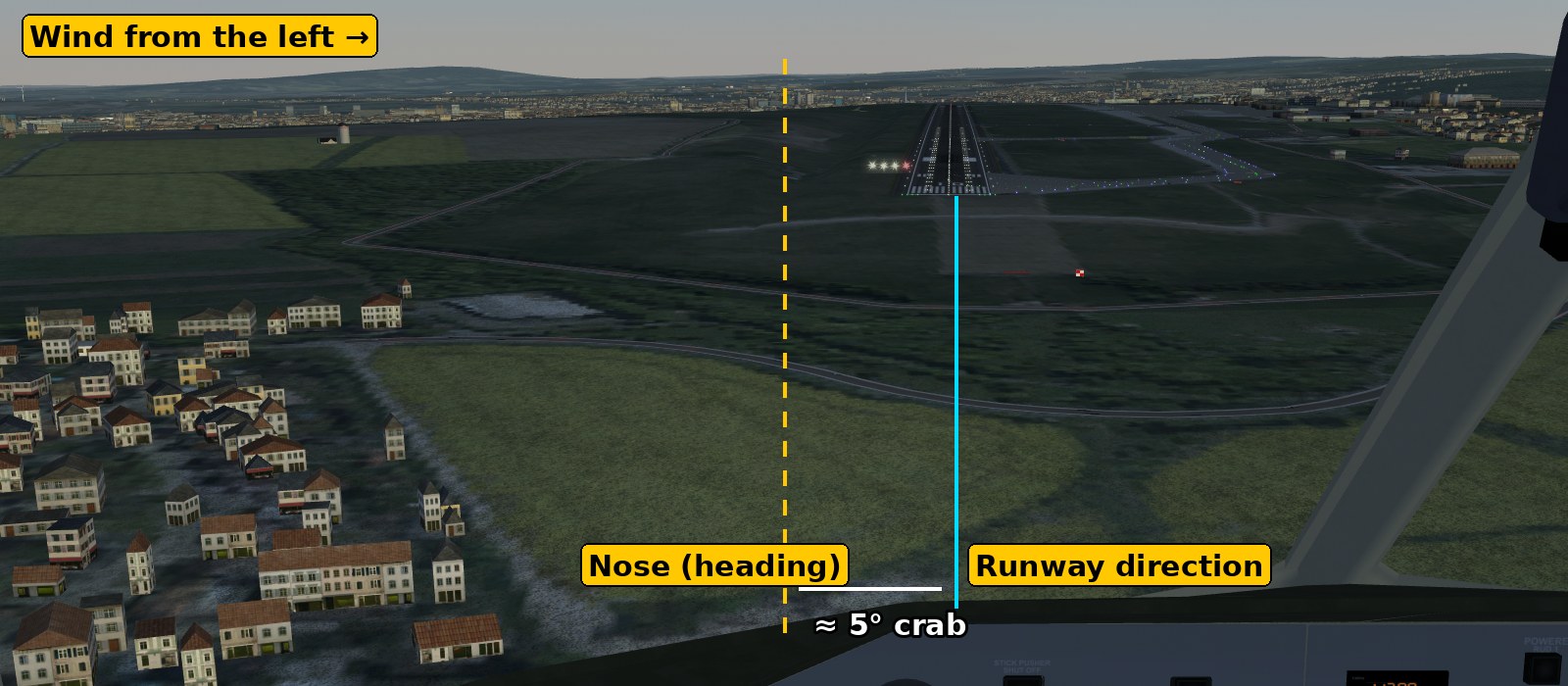
The Dash 8-200 does not show the wind in the cockpit. You recognise it by the drift: heading and actual flight path differ.
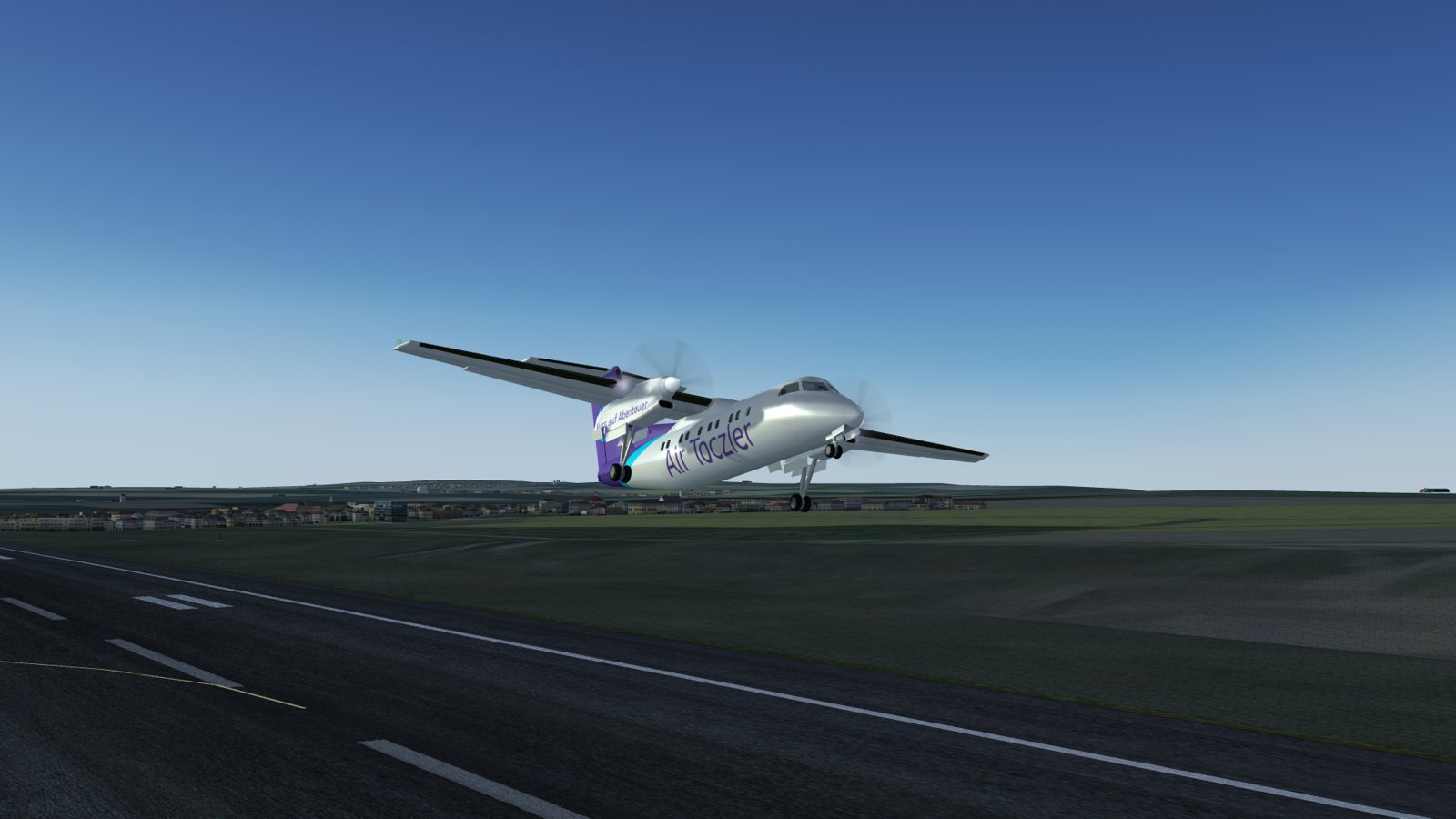
In the picture below the wind comes from the left: the nose points about 5° left of the runway, yet the aircraft flies straight towards it.
Go-around#
Callout |
Action |
|---|---|
“Go around” |
full power, nose up, flaps to 15°, climb at about 130 kt (flap-15 speed plus 10) |
“Positive rate” |
gear up |
Pattern altitude |
flaps up, new pattern or new approach |
Engine failure after takeoff#
Identify the failed engine (torque drops, the aircraft yaws towards the failed side), hold it with rudder, feather the propeller, mayday call (transponder 7700), return to the airfield. Land with flaps 15° and Vref + 18 kt, without reverse, wheel brakes only. Bank at most 15°.
Quick reference#
Phase |
Numbers |
|---|---|
Takeoff |
flaps 5°, prop 1200, VR ~100–107 kt, 130 kt up to 1000 ft |
Climb |
flaps 0°, 170 kt, prop 1050 |
Pattern |
2000 ft above the field, 150 kt, bank up to 25° |
Final |
flaps 35°, Vref ~90–98 kt, 3° glide path, stable at 300 ft |
Landing |
flare ~50 ft, touchdown 300–600 m past the threshold, DISC, reverse down to 40 kt |
Crosswind |
crab, wing into the wind, align below 25 ft, gust additive up to 10 kt |