Aerosonde#
In 1998 the Aerosonde “Laima” became the first unmanned aircraft to cross the Atlantic: 3270 km from Newfoundland to Scotland in 26 h 45 min, with 13 kg take-off mass, a 1 hp engine and about 4 kg of petrol. This page shows how to fly my replica in FlightGear and run the simulations yourself. The full story is in the (German) article Aerosonde: Mit 13 kg und 1 PS über den Atlantik.
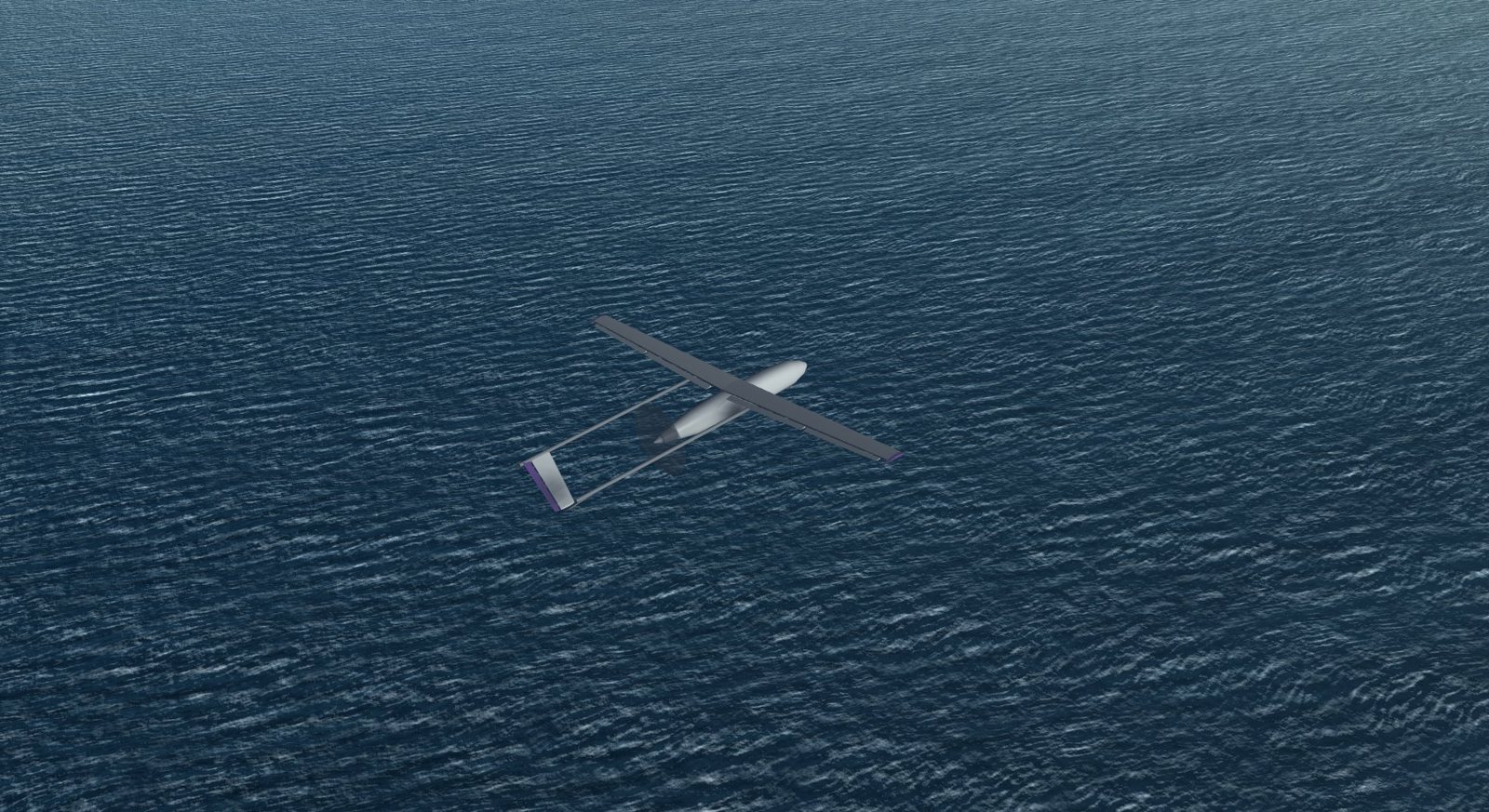
The package contains the aircraft for FlightGear and the Python scripts I used to build the 3D model, the flight model and the simulations. Wingspan, masses, engine power, cruise speed and fuel burn are documented values. Wing chord, drag and propeller are assumptions.
Download#
cd "$FG_BASIS/downloads"
curl -LO https://codemich.de/medien/aerosonde/aerosonde.zip
unzip -o aerosonde.zip
cp -r aerosonde/Aircraft/Aerosonde "$FG_BASIS/Aircraft/"
cd "$env:FG_BASIS\downloads"
curl.exe -LO https://codemich.de/medien/aerosonde/aerosonde.zip
Expand-Archive -Force aerosonde.zip .
Copy-Item -Recurse -Force aerosonde\Aircraft\Aerosonde "$env:FG_BASIS\Aircraft\"
Flying#
The real Aerosonde was launched from the roof of a moving car. FlightGear cannot do that, so it starts in the air, here over Bell Island in Newfoundland with a 20 kt westerly wind:
"$FG_BASIS/werkzeuge/starten.sh" --aircraft=aerosonde --in-air --altitude=900 --vc=40 \
  --lat=47.64 --lon=-52.93 --heading=55 --wind=250@20 --timeofday=morning --disable-real-weather-fetch
& "$env:FG_BASIS\werkzeuge\starten.ps1" "--aircraft=aerosonde" "--in-air" "--altitude=900" "--vc=40" `
  "--lat=47.64" "--lon=-52.93" "--heading=55" "--wind=250@20" "--timeofday=morning" "--disable-real-weather-fetch"
Three seconds after the start the engine runs and the autopilot takes over. It holds heading, altitude and speed, just like the real Aerosonde, which flew the whole way on its own. When it switches on it takes the current heading and altitude as targets, the speed is 40 kt. You can change them with the module from Control with Python:
from fg_steuerung import Fg

fg = Fg()
fg.set("/fdm/jsbsim/ap/heading-setpoint-deg", 70)     # heading in degrees
fg.set("/fdm/jsbsim/ap/altitude-setpoint-ft", 2000)   # altitude in ft above sea level
fg.set("/fdm/jsbsim/ap/speed-setpoint-kt", 45)        # indicated airspeed in kt
print("ground speed:", fg.get("/velocities/groundspeed-kt"), "kt")
Set /fdm/jsbsim/ap/enabled to 0 to switch it off and fly yourself. With a tailwind you see the key effect immediately: 40 kt through the air, but 55 to 60 kt over the ground.
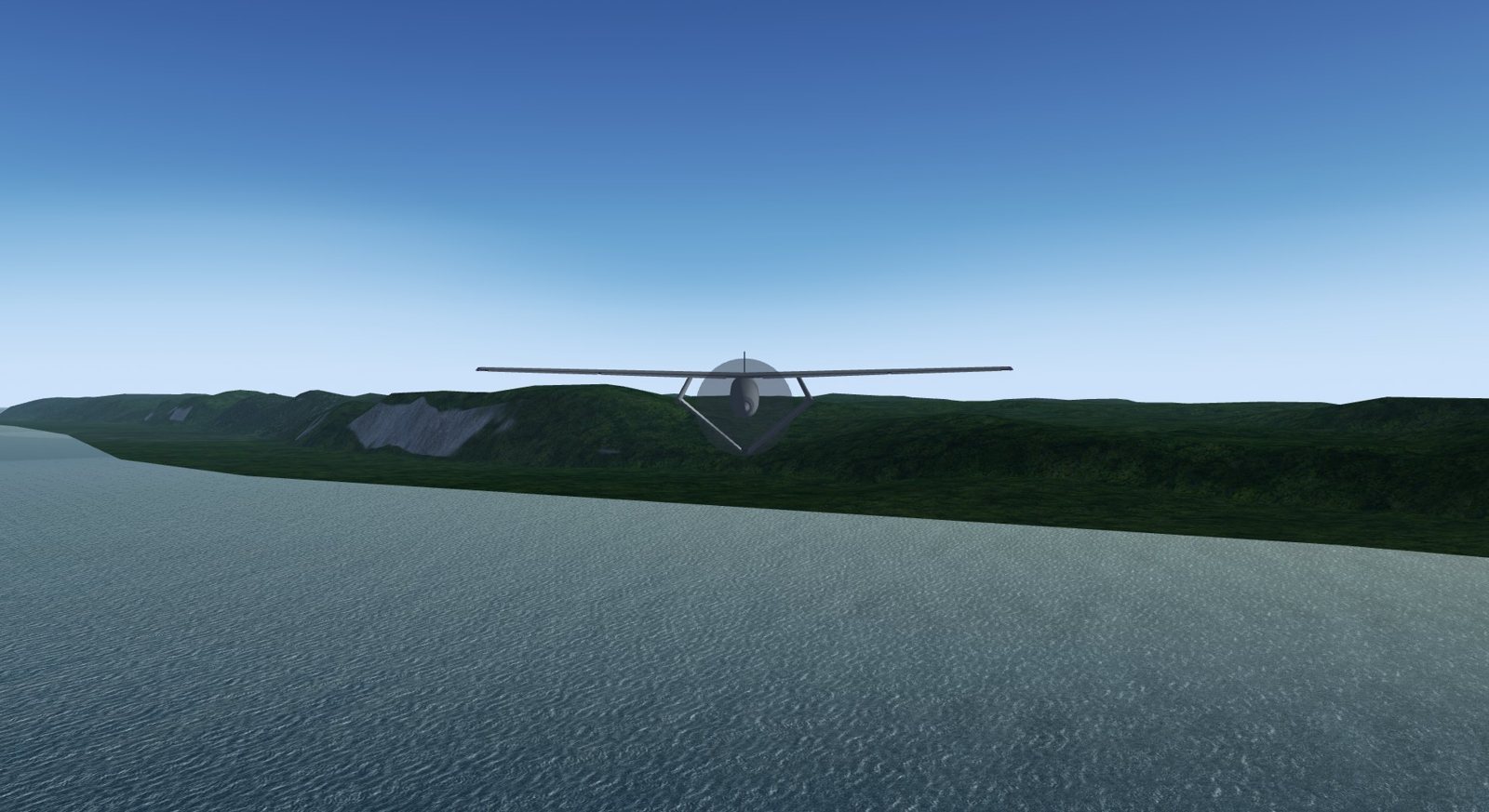
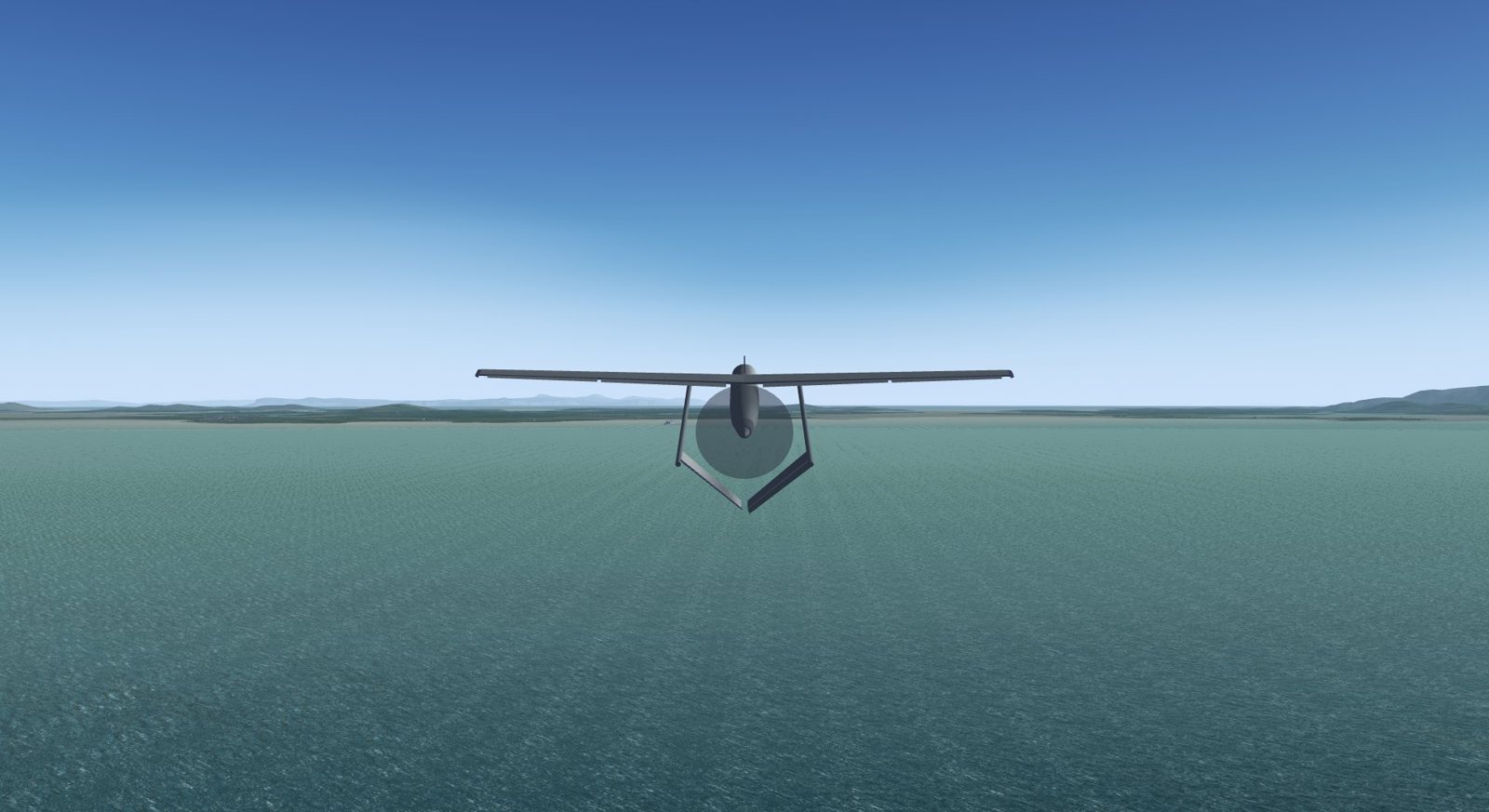
Left the start near Bell Island, right the destination off Benbecula. For the arrival use --lat=57.46 --lon=-7.62 --heading=95 --timeofday=afternoon.
Run the numbers yourself#
The simulations run in standalone JSBSim, without FlightGear and without a screen, and only need Python. Install the packages once:
python3 -m venv "$FG_BASIS/aerosonde-venv"
"$FG_BASIS/aerosonde-venv/bin/pip" install jsbsim matplotlib pillow
python -m venv "$env:FG_BASIS\aerosonde-venv"
& "$env:FG_BASIS\aerosonde-venv\Scripts\pip.exe" install jsbsim matplotlib pillow
Then, in the package’s werkzeuge folder: generate the flight model, test level flight and stall, compute the Atlantic crossing with wind and draw the pictures.
cd "$FG_BASIS/downloads/aerosonde/werkzeuge"
PY="$FG_BASIS/aerosonde-venv/bin/python"
"$PY" fdm_bauen.py
"$PY" tests.py
"$PY" wind_rechnung.py
"$PY" diagramme.py
"$PY" anim_atlantik.py
cd "$env:FG_BASIS\downloads\aerosonde\werkzeuge"
$PY = "$env:FG_BASIS\aerosonde-venv\Scripts\python.exe"
& $PY fdm_bauen.py
& $PY tests.py
& $PY wind_rechnung.py
& $PY diagramme.py
& $PY anim_atlantik.py
The first run of wind_rechnung.py takes a few minutes because it simulates 24 level flights. The results go to leistung.csv and atlantik.csv, the pictures to the Bilder folder (each in German and English). If you change fdm_bauen.py, for example the drag CD0 or the fuel burn, it also regenerates the flight model for FlightGear. Copy Aircraft/Aerosonde to your aircraft folder again afterwards. The 3D model is built by modell_bauen.py in Blender: blender --background --python modell_bauen.py. The script comments are in German.
Results#
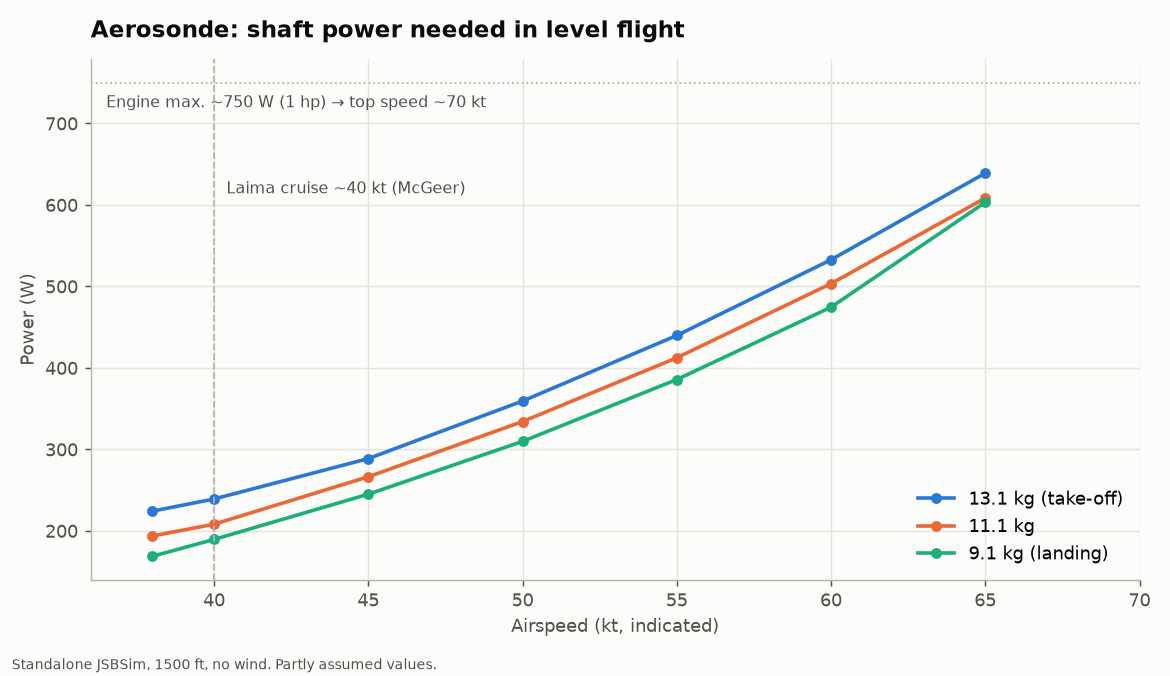
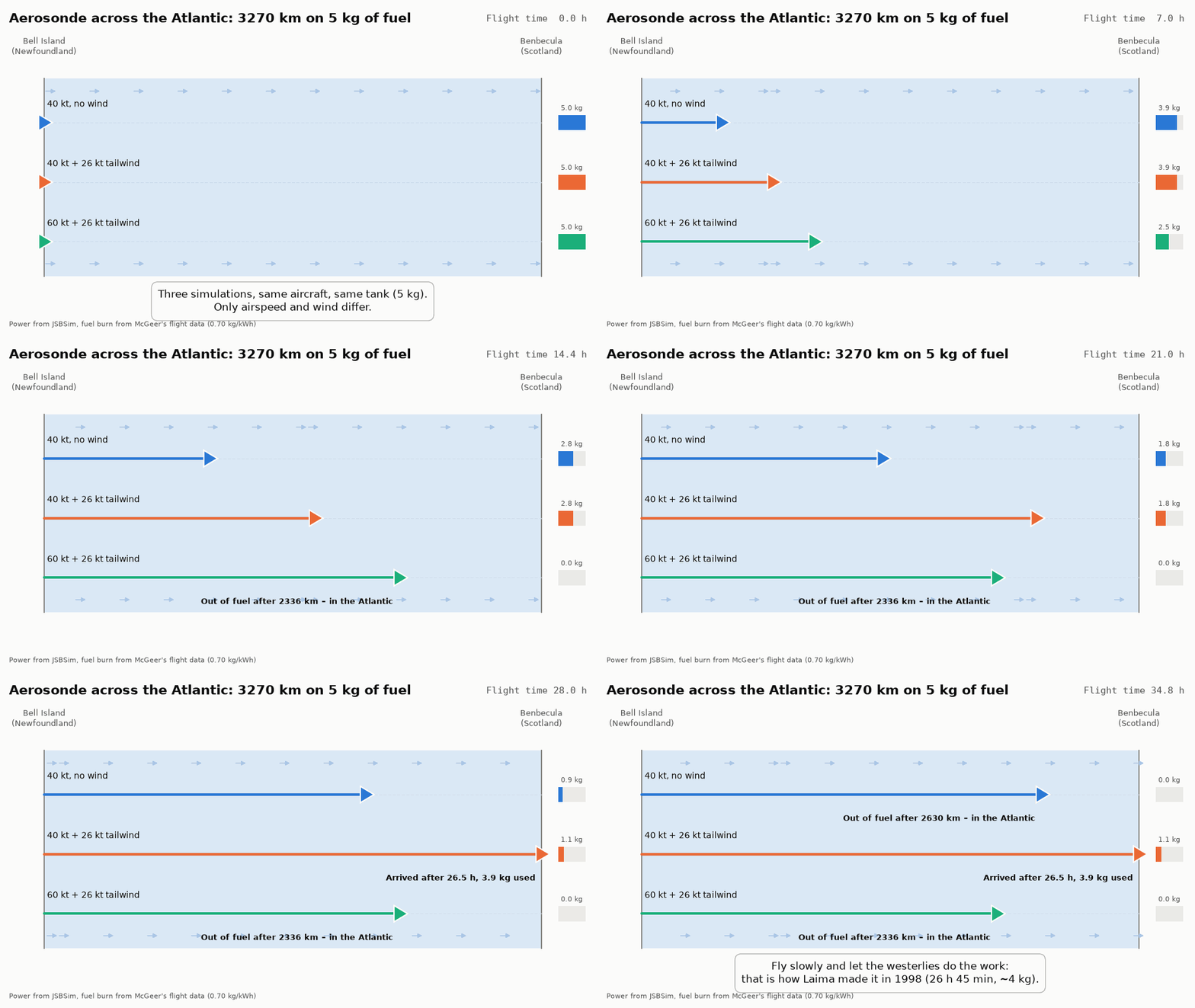
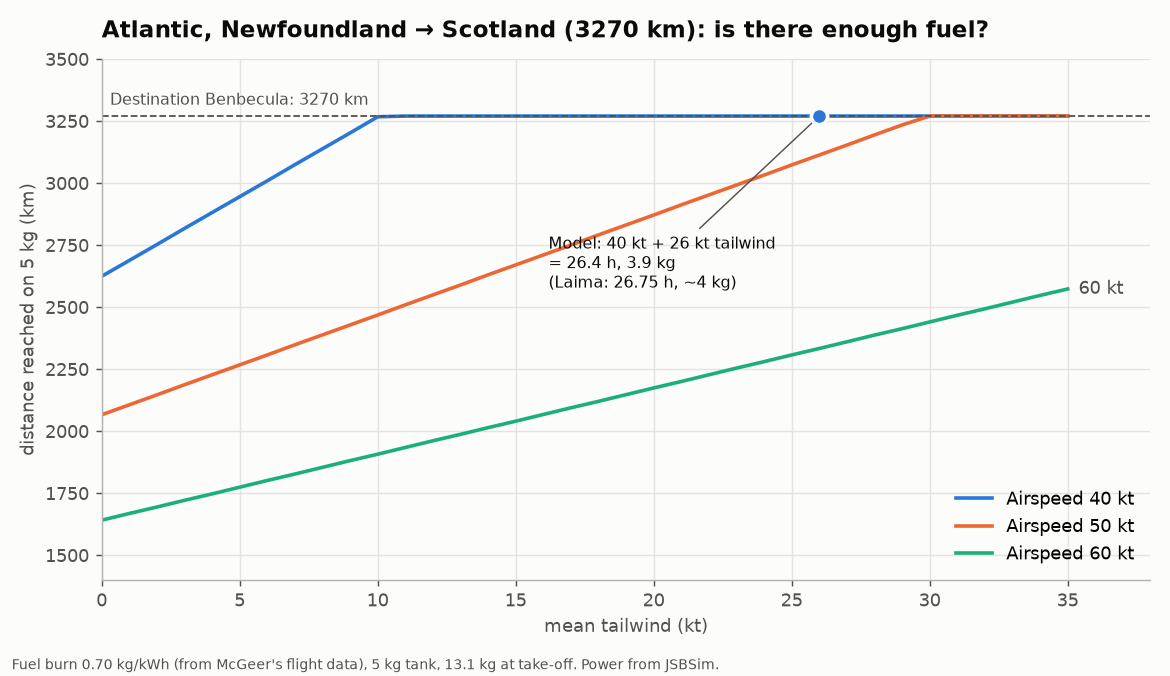
At 40 kt about 200 to 240 W are enough, at 65 kt it is over 600 W. Flying slowly is much more economical. With the fuel burn from the original report (0.70 kg per kWh) it only gets about 2200 to 2600 km without wind. Only the tailwind gets it across the Atlantic:
Airspeed |
Tailwind |
Result |
|---|---|---|
40 kt |
none |
out of fuel after about 2630 km |
40 kt |
15 kt |
arrived after 31.6 h with 4.6 kg used |
40 kt |
25–26 kt |
arrived after 26.4–26.9 h with 3.9–4.0 kg (Laima: 26 h 45 min, about 4 kg) |
60 kt |
up to 35 kt |
does not arrive |
Limits#
Wing chord, drag and propeller are estimates. The fuel burn is derived from the real flight data, so flight time and fuel match even if individual values may be off.
The model has no sensors and no cockpit, it is meant for flying and calculating.
Take-off and landing are not modelled: it starts in the air and has no landing gear. The real Laima landed without landing gear in a field on South Uist.